Curiosities • free
Which water should you drink? Composition, labels and individual needs
Mineral, spring, tap or medicinal water? A detailed, sourced guide to mineral content, pH and choosing water for everyday life, meals and exercise.
1. The essentials: composition, safety and regular drinking
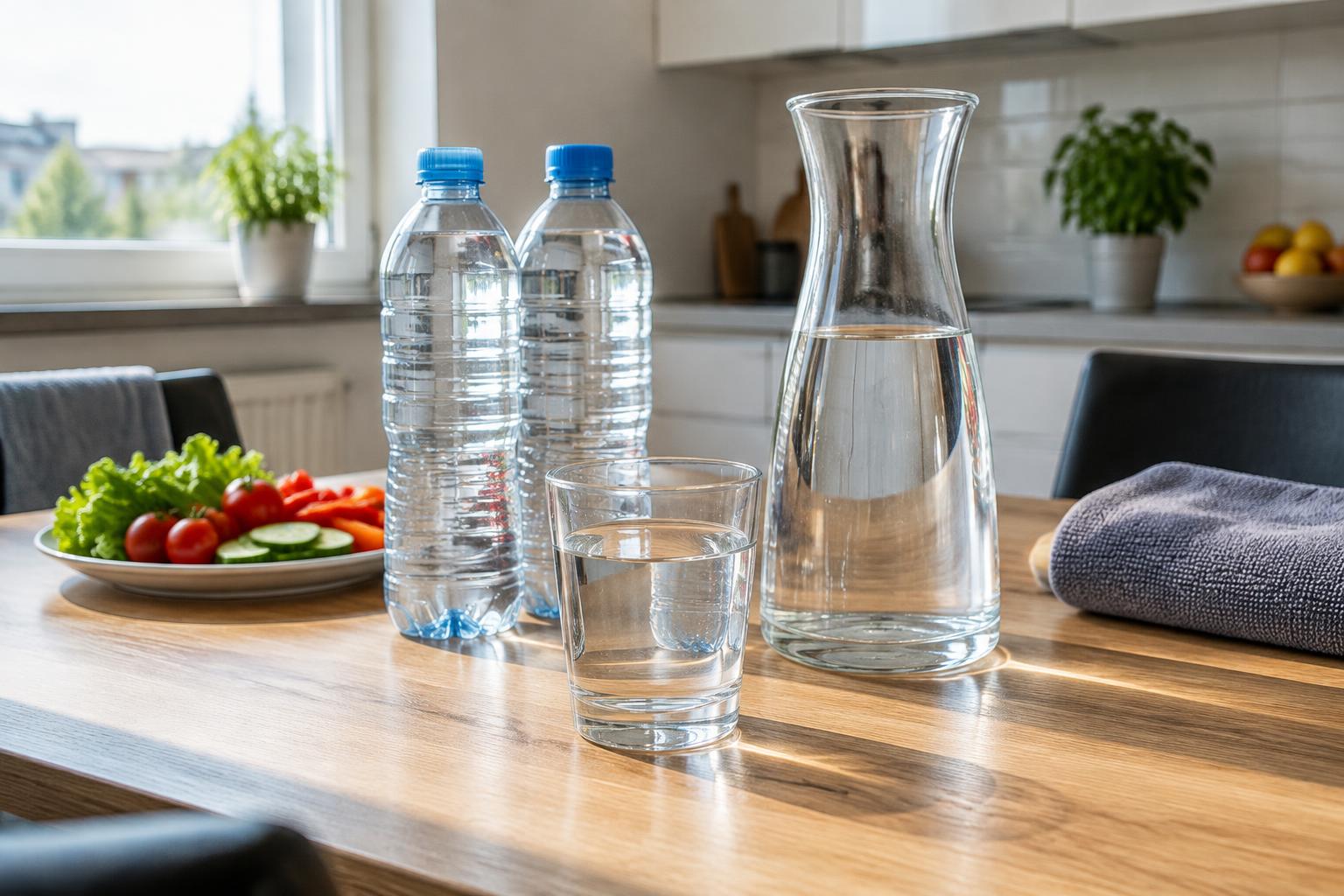
Water primarily hydrates. It supports temperature regulation, transport of substances and removal of metabolic waste. It does not need a high mineral content to do this. Spring water or safe tap water is not “empty water”; a lower mineral concentration simply contributes fewer minerals to the diet.
When buying water, know what you are paying for: taste, convenience, carbonation or a particular calcium and magnesium content. Bottled water is not compulsory if safe mains water is available. No single brand or mineral level is best for everyone.
2. Mineral, spring, table and medicinal water are different
These distinctions mainly reflect Polish and EU labelling rules. Names and the legal status of medicinal water may differ by country. “Mineral” does not mean “highly mineralised”, and a spa town name does not prove a product has therapeutic effects.
- Natural mineral water: from an underground source, originally pure and with a characteristic, essentially stable composition. It can contain very few or very many minerals. Look for the full category name and composition analysis.
- Spring water: also underground in origin and subject to safety requirements. It usually has a mild taste and modest mineral content. Suitable for drinking, cooking and making beverages; it need not supply substantial calcium or magnesium.
- Table water: made by adding specified minerals or combining suitable waters under applicable rules. Its composition is adjusted during production. This does not automatically make it inferior, but it is not the same as natural mineral water.
- Medicinal water: has a specific composition and documented properties for particular uses. High mineral content alone does not make water medicinal. Water from spa drinking halls should not be selected just by taste or advertising; indications, amount and duration need to be established.
3. Mineral content: what does mg/l mean?
Milligrams per litre (mg/l) indicate the amount of a substance in one litre. Total mineralisation describes the combined dissolved mineral content. Labels may also show “dry residue” measured by a specified method. These figures are useful but not always identical; compare like-labelled measurements.
A common classification: very low mineral content — up to 50 mg/l; low — up to 500 mg/l (including the previous group); medium — above 500 up to 1500 mg/l; high — above 1500 mg/l. These describe composition, not quality grades. EU Annex III indications refer to fixed residue.
Two waters at 1500 mg/l may be very different: one supplies more calcium and magnesium, the other mainly sodium and bicarbonate. The total alone cannot answer “is this right for me?”. Look at individual ions.
4. Calcium, magnesium, sodium and other constituents
Calcium supports bones and muscle function; magnesium participates in enzyme, muscle and nervous-system function. Water can supplement both, but does not replace varied food or deficiency treatment. EU thresholds for “contains calcium” are above 150 mg/l and “contains magnesium” above 50 mg/l. These are not minimum requirements for all water or therapeutic doses.
- Sodium (Na+): needed for fluid balance, but food often supplies too much. “Suitable for a low-sodium diet” means below 20 mg/l. Useful when sodium restriction is prescribed. High-sodium water is not automatically forbidden for every healthy person; volume and the whole diet matter.
- Bicarbonate (HCO3−): affects taste and buffering properties. The “contains bicarbonate” threshold is above 600 mg/l. This does not mean “deacidifying the body” or replacing reflux medication. High bicarbonate may come with high sodium; check both.
- Sulphate (SO4²−), chloride (Cl−) and other ions: matter for taste and tolerance. Some magnesium- and sulphate-rich waters can have a laxative effect. More is not always better; avoid experimenting with strongly mineralised water during diarrhoea or intestinal symptoms.
- Fluoride (F−): above 1.5 mg/l, EU natural mineral water needs a warning that it is unsuitable for regular consumption by infants and children under 7. Labels may carry important restrictions; do not choose such water for the whole family without checking.
5. How many minerals will you actually drink?
The calculation is simple: concentration in mg/l × litres consumed = amount in mg. With 200 mg/l calcium and 60 mg/l magnesium, half a litre supplies 100 mg calcium and 30 mg magnesium; 1.5 litres supplies 300 mg and 90 mg. These are example values, not a recommendation to drink 1.5 litres of this water.
Calculate sodium the same way: water at 800 mg/l supplies 400 mg sodium in half a litre. That is not 400 mg salt; an approximate salt equivalent is sodium × 2.5, about 1 g. When limiting sodium, also count bread, cheese, processed meats, ready meals and added salt.
Three example labels compared
Invented teaching examples, not actual brands. All values in mg/l; selected constituents, not a complete analysis.
| Constituent / parameter | A | B | C |
|---|---|---|---|
| Total mineralisation | 300 | 1100 | 3000 |
| Calcium (Ca²+) | 45 | 200 | 80 |
| Magnesium (Mg²+) | 10 | 60 | 25 |
| Sodium (Na+) | 8 | 15 | 800 |
- A: hydrates and supplies modest minerals. A reasonable everyday choice; low mineral content does not mean poor quality.
- B: more calcium and magnesium with little sodium. May supplement the diet if not contraindicated.
- C: highest total but not the most calcium or magnesium. High sodium means it is not equivalent to B for sodium restriction. The number 3000 does not make it best or medicinal.
6. Water pH: there is no magic number
pH describes acidity or alkalinity: around 7 is neutral, lower acidic, higher alkaline, depending on measurement conditions. It is not a measure of mineral content or health benefit. Dissolved carbon dioxide lowers pH, so sparkling water may have a lower pH despite a mineral composition similar to its still version.
WHO does not set a health-based target pH for drinking water. It matters for treatment and pipe corrosion but does not identify one ideal pH for people. Lungs and kidneys tightly regulate blood pH; alkaline water is not a treatment for “body acidity”. Acid–base disorders require medical care, not a more expensive bottle.
There is no convincing evidence that healthy people need pH 8–9 water to hydrate better or prevent disease. Small studies and isolated findings do not justify “detox”, cancer treatment or rejuvenation claims. Saliva or urine pH is not a measure of whole-body pH to use when choosing water.
7. Tap versus bottled: compare data, not prestige
Drinking mains water is subject to quality requirements and monitoring. Its composition depends on the source and treatment: it may contain fewer minerals than one bottled water and more than another. Without local data, it is not fair to say every bottle is better or every tap water identical.
Check the latest supplier report for your area and public health notices. Ask for calcium, magnesium, sodium and hardness if absent. Hardness mainly reflects calcium and magnesium; kettle scale does not prove water is harmful. Building plumbing also affects quality at the tap. Private well water needs appropriate testing, not just a clear appearance or good taste.
Use cold tap water for drinking and cooking. After stagnation, run it until noticeably cool. Choose a filter for a specific problem and replace cartridges regularly. Not every filter removes microbes or all contaminants; neglected cartridges can worsen quality. Reverse osmosis reduces many dissolved constituents, rather than increasing mineral content.
8. Water for everyday life and meals
A healthy person can drink safe tap, spring or mineral water they tolerate well. To increase calcium and magnesium intake, choose their concentrations, not just the total. Medium-mineral water can be practical but is not mandatory. High-mineral water may supplement the diet; volume depends on composition and health, not “more is better”.
There is no established need for a separate “meal water”. A reasonable amount with food does not switch off digestion by “diluting juices”. Choose taste and tolerance: still water in small portions may suit fullness or reflux better. Do not attribute treatment of digestive complaints to a particular water without evidence and advice.
9. Exercise and heat: mineral water is not a sports drink
For short, moderate exercise — such as 15–45 minutes of chair exercises, bands or gentle walking — plain water and normal meals usually suffice. Sports drinks or high-mineral water are not compulsory. Keep a drink nearby and take small portions; heat and heavy sweating increase needs.
During prolonged exercise, especially over an hour, or heavy sweating, sodium replacement and sometimes carbohydrates may be needed. Duration, temperature, sweat loss and food matter. High total minerals do not guarantee appropriate sodium or isotonic composition. Magnesium cannot replace sweat sodium, and a “sports water” label does not guarantee suitability.
Do not force large amounts “in reserve”. Excess drinking can lower blood sodium, including during exercise and with sports drinks. There is no universal safe litres-per-hour limit. Individualise prolonged-exercise hydration; seek advice with chronic illness. Confusion, severe weakness, fainting or persistent vomiting require urgent help.
10. Sparkling, still or flavoured?
Plain sparkling water hydrates too. Carbon dioxide does not remove its value, but may cause belching and bloating. With reflux, observe tolerance. “Sparkling” does not mean mineral-rich or sodium-rich; these are separate traits. Choose carbonation for comfort.
Flavoured water may contain sugar, juice, acids or sweeteners. Read ingredients and nutrition, not just the front label. Frequent sipping of acidic drinks, particularly flavoured ones, promotes enamel erosion. Plain unsweetened water is simplest for daily use; do not hold acidic drinks in your mouth or sip them all day.
11. Spa and medicinal waters: treatment needs caution
Spa halls may offer bicarbonate, sulphate, sodium-chloride waters or waters with particular trace elements. Tradition does not mean every water treats everything. Check the specific water’s official characteristics, indications, contraindications and use instructions. Advice for one source should not be applied to another.
There is no universal dose or before/after-meal rule: these depend on the product, purpose and health. High sodium may conflict with restrictions; large amounts of some minerals matter in kidney failure. Waters unusually rich in trace elements should not be an all-day thirst drink. Discuss a course with your clinician, particularly if taking medication.
12. After 50: health matters more than rankings
Thirst may weaken with age; mobility problems or worry about urination may limit drinking. Small portions linked to waking, meals and walks can help. Do not restrict fluids on your own because of incontinence; discuss the problem with a clinician. Fluids also come from other drinks and food.
EFSA gives adequate total water intake of 2.0 l/day for adult women and 2.5 l for men, including food, in moderate temperature and activity. This is not an instruction to drink that much bottled water alone or a universal minimum or maximum. Illness, medicines, heat and exercise change needs.
With kidney disease, ask about fluid volume and suitable composition instead of trusting “for kidneys” advertising. With heart failure and swelling, follow your care plan. For sodium restriction, compare Na+ and volume. Do not stop medicines or change prescribed fluid amounts based on this article.
13. Storage, price and sensible buying
Store as labelled, away from sun and heat. After opening follow the producer’s instructions; there is no single deadline for all packages. Drinking from a bottle introduces mouth microbes. Wash and dry reusable bottles and carafes regularly. Do not leave opened drinks for days in a warm car.
Compare price per litre, not per bottle. If an expensive water has a composition similar to a cheaper one or safe local tap water, the premium may buy convenience or branding, not extra health benefit. If buying for calcium or magnesium, check the amount per serving. No brand ranking: products and composition can change.
14. Before buying: six questions for the label
The best choice is safe water you enjoy, drink regularly and that suits your health. Without specific indications, you do not need to organise your day around several bottles. A suitable diet, activity and regular drinking matter more than a prestigious label.
- What category is it and where does it come from?
- What is its mineral content and how was it measured?
- How much calcium and magnesium, including in my serving?
- How much sodium and does it fit my care advice?
- Are there sugar, additives, contraindications or warnings?
- Is the price per litre justified compared with other safe options?
15. Sources
Written in original wording from legislation, guidance and medical information. Labelling criteria are distinguished from health advice. Sources checked 12 November 2026. This article is not a clinical review or a quality assessment of a particular brand.
- [1] NIZP PZH — Definicje wód butelkowych
Water categories and mineral classification; education, not a brand ranking.
- [2] EU — Directive 2009/54/EC, Annexes I & III
Natural mineral water definition and labelling thresholds, not treatment doses.
- [3] WHO — pH: history of guideline development
No health-based pH target; operational water-quality relevance.
- [4] EU — Directive 2003/40/EC, Article 4
Fluoride warning above 1.5 mg/l for young children.
- [5] Inspekcja Sanitarna — Woda do spożycia
Mains monitoring and building plumbing; not a test of a specific home.
- [6] EFSA — Scientific Opinion on Dietary Reference Values for water (2010)
Total water from drinks and food in moderate conditions; not an individual prescription.
- [7] Hew-Butler et al. — Exercise-Associated Hyponatremia: 2017 Update
Review of overdrinking and exercise hyponatraemia, mainly endurance activity.
- [8] Polska — Rozporządzenie o potwierdzaniu właściwości leczniczych (2018)
Testing and confirming medicinal raw materials; not proof for any arbitrary bottle.
- [9] EU — Regulation 1169/2011, Annex I
Salt equivalent: sodium × 2.5. Sodium and salt are different quantities.
- [10] Mayo Clinic — Alkaline water: Better than plain water?
Limited alkaline-water evidence, without proven general superiority.
- [11] CDC — About Choosing Home Water Filters
Match filters to contaminants and maintain them; most pitcher filters do not remove germs.
- [12] Mayo Clinic — Water after meals: Does it disturb digestion?
Water with meals does not disrupt digestion; health-dependent exceptions.
- [13] American Dental Association — Sparkling Water and Your Teeth
Plain sparkling versus acidic flavours and sugar; effects on teeth differ.
- [14] ESPEN — Clinical nutrition and hydration in geriatrics (2022)
Older-adult guidance with clinical exceptions, including heart and kidney failure.
- [15] National Kidney Foundation — Potassium
Kidneys, medicines and potassium; check advice before adding electrolytes.