Curiosities • free
Achenbach syndrome — a sudden finger bruise that looks alarming
What Achenbach syndrome (paroxysmal finger haematoma) is, its symptoms, how to tell it from ischaemia, what to do during an episode and what is known about supplements. With sources.
1. What is Achenbach syndrome?
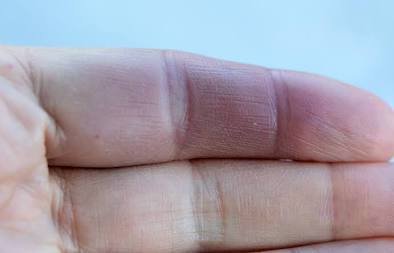
Achenbach syndrome, also called paroxysmal finger haematoma, is a sudden rupture of a small vessel in a finger, either spontaneous or after minor pressure. A painful bluish bruise appears under the skin. It was described in 1958 by the German physician Walter Achenbach. It mostly affects middle-aged people, more often women, and usually resolves on its own within days.
It is benign: it does not permanently damage the finger, does not cause tissue death and, according to available reports, does not signal serious vascular disease. The cause is unknown. Clotting and vascular tests are usually normal. Because the literature is mostly case reports and small series, knowledge is limited.
2. Typical symptoms
An episode starts suddenly. Many people describe it as the finger being “pressed out” after gripping a bag, wringing a cloth, pressing hard, or for no clear reason at all.
- Sudden sharp or burning pain or tingling, sometimes minutes before the bruise appears.
- Bluish discolouration, usually on the palm side of a finger near a joint; often the middle or index finger.
- Swelling and tenderness; the finger may be less usable because of pain.
- The fingertip usually stays warm and pink, with normal sensation and circulation.
- Pain fades within hours and the bruise within days; episodes may recur weeks or years apart.
3. Warning signs — when it may be something else
A doctor diagnoses it from its appearance and course; a photo taken during an episode helps, because the bruise may be gone by the appointment. The key is to distinguish it from acute finger ischaemia (e.g. an embolism), which needs urgent care. Other possibilities include Raynaud’s phenomenon, vasculitis, thrombosis, injury, bleeding disorders or anticoagulant effects.
- Seek urgent help if the fingertip is cold, pale, white or black, if you lose sensation, or if pain worsens instead of easing.
- See a doctor after a first episode, or if you have bruises in many places, nose or gum bleeding, fever, or take blood thinners.
4. What to do during an episode
Treatment is symptomatic, as it resolves on its own. There is no need to puncture the bruise or have a procedure.
- Stop the activity and rest the finger; do not massage or press the bruise.
- In the first hours apply a cool pack wrapped in cloth for 10–15 minutes, never ice directly on skin.
- Raise the hand above heart level to reduce swelling.
- After 1–2 days gentle warmth may help the bruise fade.
- For strong pain, paracetamol at the leaflet dose is usually safer than drugs that may increase bleeding; ask a doctor or pharmacist about the choice.
- Take a photo of the finger and note the date and circumstances — useful at the appointment.
5. Prevention — can episodes be prevented?
There is no proven way to prevent it and no curative drug. Since some episodes follow pressure, it is reasonable to limit strong, focused pressure on the fingers. These are common-sense tips, not research findings.
- Carry shopping in a backpack or trolley rather than on your fingers; use wide, padded handles.
- Avoid wringing cloths and laundry by hand; use an opener or rubber pad for jars.
- Wear padded gloves for gardening, workshop jobs and tool use.
- When training with bands or TRX, grip with the whole hand, wrap the band around a handle rather than your fingers, and do not squeeze longer than needed.
- Protect your hands from cold — warm gloves in winter.
6. Supplements and diet “for blood vessels” — what does the evidence say?
Online sources and AI assistants often recommend “sealing blood vessels” with supplements. We checked these claims. The key conclusion: no supplement has been studied in Achenbach syndrome and there is no evidence that any prevents episodes. Below is what is known about each in other uses.
- Rutin and vitamin C: vitamin C deficiency (scurvy) does cause fragile vessels and bruising, so correcting a deficiency helps. With normal levels there is no evidence of extra benefit. Rutin has weak clinical data. The simplest approach is daily vegetables and fruit (peppers, parsley, citrus, blackcurrants, kiwi).
- Diosmin and hesperidin: medicines and supplements used in chronic venous insufficiency (legs, varicose veins). Reviews show a modest effect on leg swelling and symptoms, but they have not been studied in finger haematomas. They may cause stomach upset and interact with medicines.
- Zinc: needed for tissue healing, but no evidence it protects finger vessels. Long-term excess can lower copper levels.
- Vitamin K2: vitamin K is needed for blood clotting, but without a deficiency a supplement does not “improve” clotting beyond normal. Warning: vitamin K weakens anticoagulants such as warfarin or acenocoumarol — do not take it with these medicines without a doctor.
7. Summary and safety
Achenbach syndrome looks worrying but is benign and resolves on its own. The key is recognising warning signs (cold, pale finger, loss of sensation, worsening pain) and acting urgently then. After a first episode, show a doctor a photo and discuss your medicines. Supplements have no proven effect in this syndrome; talk to a doctor or pharmacist before using them, especially if you take blood thinners. This text is educational and does not replace medical advice.
8. Sources
Written in original wording. Knowledge of Achenbach syndrome comes mainly from case reports, so conclusions are cautious. Sources checked 5 November 2026.
- [1] DermNet — Achenbach syndrome
Accessible dermatology overview: symptoms, course, management.
- [2] Kordzadeh A. i wsp. Is Achenbach’s syndrome a surgical emergency? A systematic review. Eur J Trauma Emerg Surg 2016
Review of reported cases; benign, usually no intervention needed. Evidence based on case reports.
- [3] PubMed — przeglądy i serie przypadków „paroxysmal finger hematoma”
Current publications, including differential diagnosis from digital ischaemia.
- [4] NHS — What are bruises?
General bruise self-care: cooling, elevation, when to see a doctor.
- [5] NIH Office of Dietary Supplements — Vitamin C
Vitamin C deficiency, scurvy, dietary sources.
- [6] Cochrane — Phlebotonics for venous insufficiency (Martinez-Zapata i wsp., 2020)
Review of phlebotonics (incl. diosmin) for leg venous insufficiency — not finger haematomas.
- [7] NIH Office of Dietary Supplements — Zinc
Role of zinc, upper limits and effects of excess.
- [8] NIH Office of Dietary Supplements — Vitamin K
Vitamin K in clotting and interaction with warfarin.