1. Movement
Walking, strength and balance work support circulation, fitness and independence. WHO recommends 150–300 minutes of moderate activity per week for adults, plus muscle strengthening on at least 2 days; build up gradually.
Free guide + Premium programme
The hippocampus is a small, paired structure deep inside the brain. It helps form new memories, organise experiences and navigate space. It does not work alone: memory depends on many brain regions working together and on the health of the whole body.
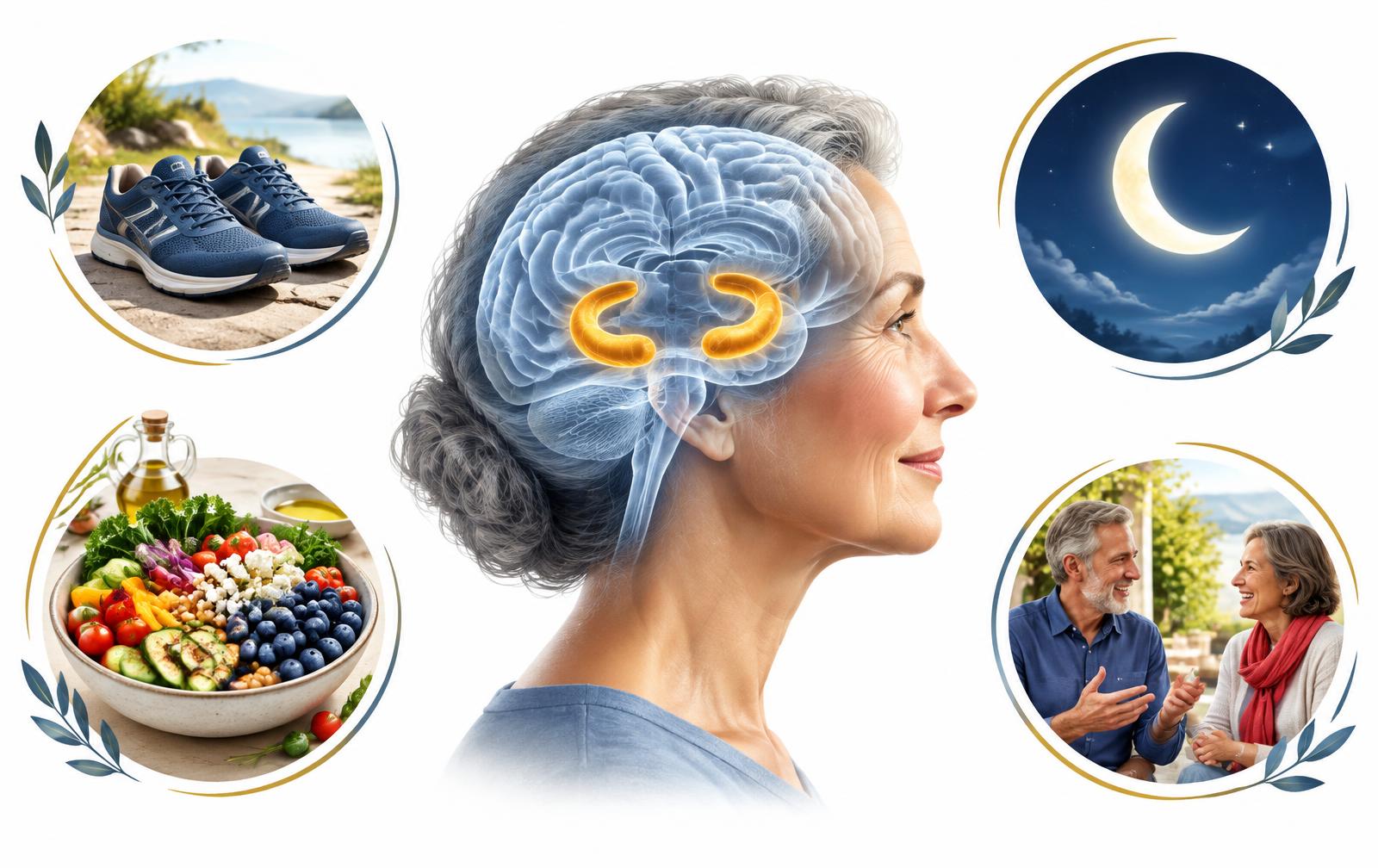
A useful simplification is to think of it as an organiser of new memories. Its main roles include:
With age, recalling a name or where you put your keys may take longer. Slower recall alone does not mean dementia. The main warning signs are new difficulties that disrupt daily life, such as getting lost in a familiar place or being unable to complete a well-known task.
Walking, strength and balance work support circulation, fitness and independence. WHO recommends 150–300 minutes of moderate activity per week for adults, plus muscle strengthening on at least 2 days; build up gradually.
During sleep, the brain organises information. Regular hours, morning daylight, a calm evening and less late caffeine can help. Loud snoring with pauses in breathing should be discussed with a doctor.
The best-supported approach is an overall pattern: vegetables, berries, pulses, whole grains, nuts, fish and olive oil in place of highly processed foods. No single food or supplement “regenerates the hippocampus”.
Long-lasting tension can impair attention and sleep. Slow breathing, movement, a daily rhythm and talking to someone close can help regulate stress, but they are not treatments for neurological disease.
Conversation, going out together, or learning a route, recipe, song or device engages memory in real life. Choose a challenge that is interesting but not overwhelming.
Regular movement is associated with better cardiovascular health and cognitive performance. However, it would be wrong to promise that exercise will “enlarge the hippocampus”. A meta-analysis of eight studies involving 554 healthy older adults found no clear significant increase in hippocampal volume after aerobic training, although cardiorespiratory fitness improved. Exercise has many benefits, but science does not support simple miracle claims.
No. Occasionally slower recall can be part of ageing. What matters is a change from previous functioning and its impact on daily life.
No. Learning may require more repetition and calm, but the ability to build new skills remains throughout life.
There is no reliable evidence that a popular supplement rebuilds the hippocampus. Deficiencies, such as vitamin B12 deficiency, should be diagnosed and treated by a professional.
Arrange a consultation if memory problems are new, worsening quickly or interfering with daily activities. Sudden confusion, speech problems, facial drooping, or weakness in an arm or leg require immediate medical help. This app does not diagnose neurological conditions.
Full access only
This programme combines safe movement, recall, navigation, sleep, nutrition and relationships. It is neither treatment nor a memory test. Its aim is to build a calm, repeatable routine.
Knowledge about lifestyle and the brain is still developing. Some findings come from observational studies, so an association does not always prove cause. This programme uses safe general-health principles rather than promising to change brain structure.