Free guide
Sarcopenia — age-related muscle loss. How to recognise, stop and reverse it
Sarcopenia is the gradual loss of muscle mass, strength and function. It's not “normal ageing” that can't be helped — it's a process that can be managed very effectively at any age.
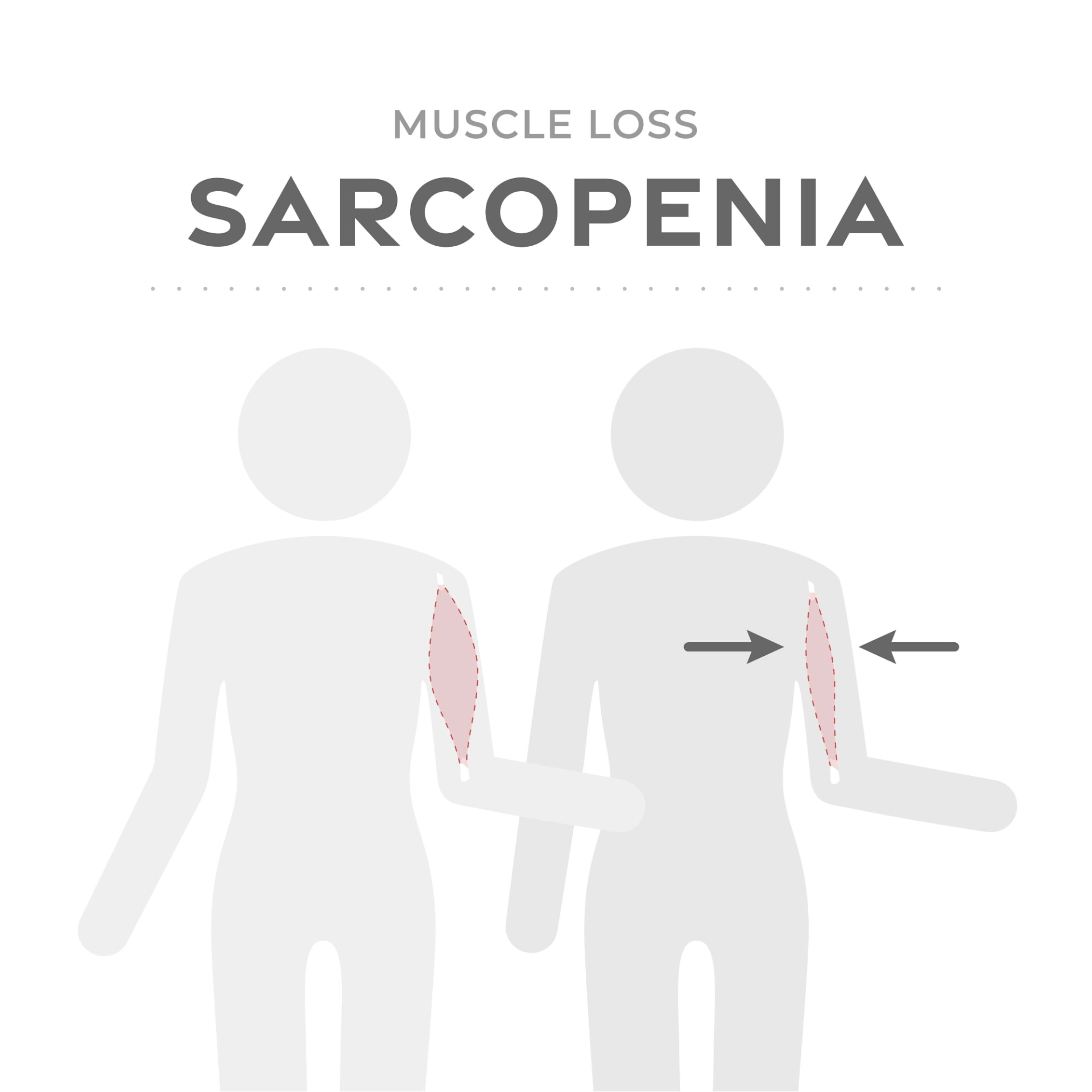
What happens in the body?
- Roughly from age 30–40 we lose about 3–8% of muscle every 10 years. After age 60 this pace clearly speeds up.
- Strength declines faster than mass itself — that's why we first notice it's harder to get up from a chair or open a jar.
- The first to disappear are “fast” fibres — the ones that save us from falling when we trip.
- Along with muscles, bones often weaken too (osteoporosis). Weak muscles + brittle bones = falls and fractures.
Why does this happen?
- Too little resistance movement — unused muscles waste away. Walking alone is healthy but not enough.
- Too little protein — with age muscles respond worse to a meal, so they need more of it than in young people.
- Hormones — in men testosterone declines slowly, in women after menopause estrogen, which protects muscles, drops sharply.
- Illness, bed rest, stress and poor sleep — even a few days in bed (e.g. in hospital) takes a noticeable chunk of strength.
Warning signs
- You get up from a chair by pushing off with your hands.
- You walk slower than before and tire faster on stairs.
- It's hard to carry a shopping bag (about 5 kg).
- You sometimes trip or fall.
- You lose weight for no reason, or clothes “hang” loose on your arms and thighs.
A simple home test — 5 chair stands
- Sit on a stable chair without wheels, backrest against the wall. Cross your arms over your chest.
- Have someone start a stopwatch. Stand up fully and sit down again — 5 times, as fast as you safely can.
- A result over 15 seconds is, according to European doctors (the EWGSOP2 group), a sign of muscle weakness — it's worth talking to a doctor.
Can't stand up without using your hands? Skip the test — that alone is reason enough to see a doctor. You'll find a fuller assessment in our 50+ Test. 50+ Test.
Three pillars of fighting sarcopenia
1. Resistance movement — the most important
- Strength exercises 2–3 times a week: chair stands, resistance bands, TRX, bodyweight.
- A muscle doesn't know whether a woman's or a man's hand holds it — it reacts to effort. By the end of a set it should feel “hard but doable”.
- Every 2–3 weeks add a bit more: 1–2 more reps or a stronger band.
- Round this out with balance exercises and daily walking.
2. Food — the building blocks for muscle
- People over 65 need about 1.0–1.2 g of protein per kg of body weight daily, and active or frail people even 1.2–1.5 g. If you have kidney disease, set the amount with your doctor.
- Spread protein across 3 meals of about 25–30 g each: eggs, curd cheese, skyr yoghurt, fish, lean meat, legumes.
- It's best to eat a protein meal within 1–2 hours after training.
- It's worth checking your vitamin D level — a deficiency weakens muscles. Sea fish provides omega-3 fatty acids.
3. Support from specialists
- Tests: a doctor may order a grip strength measurement, a body composition scan (DEXA), and blood tests (vitamin D, hormones).
- Hormones: for men with low testosterone or women going through menopause, a doctor (endocrinologist, gynaecologist, urologist) may consider hormone treatment. This is a decision for a doctor only — never do it on your own.
- Physiotherapy: a physiotherapist will help you train safely with joint pain, after injuries and surgery. Women after childbirth and surgery should consider a urogynaecological physiotherapist (pelvic floor muscles).
- Electrical stimulation (EMS): as an addition for people who can't exercise normally due to pain or injury — only under a physiotherapist's supervision.
Women and men — what's different?
| Men | Women | |
|---|---|---|
| Main hormone | Testosterone — declines slowly, about 1% a year | Estrogen — drops sharply after menopause |
| Biggest risk | Loss of strength and reaction speed | Brittle bones (osteoporosis) and weak pelvic floor |
| What to pay attention to | Hip and spine mobility | Pelvic floor and abdominal muscles, bone-strengthening exercises |
| In common | Resistance training, protein, sleep and calm — stress and lack of sleep literally “eat away” muscle | |
Can sarcopenia be prevented?
We can't stop ageing 100%, but research shows that even people over 80 and 90 gain strength through regular resistance exercise. It's never too late — the best time to start is today.
Important: this guide does not replace medical advice. Before starting training with heart disease, high blood pressure, osteoporosis, or after surgery, consult a doctor or physiotherapist.
Sources: European Working Group on Sarcopenia (EWGSOP2, 2019), PROT-AGE and ESPEN recommendations on protein for older adults, materials by Robert Soszyński.