SMSrebrna MocVitality 50+

Free guide + Premium plan

Prostate, pelvic floor and hip muscles

The pelvic floor is a „hammock” of muscles closing the pelvis from below. In men it surrounds the urethra just below the prostate; in women it supports the bladder, uterus and bowel. Together with the abdominal, gluteal, diaphragm and hip flexor muscles it forms a centre that controls bladder continence, posture, walking and sexual function. The good news: these muscles can be trained at any age.

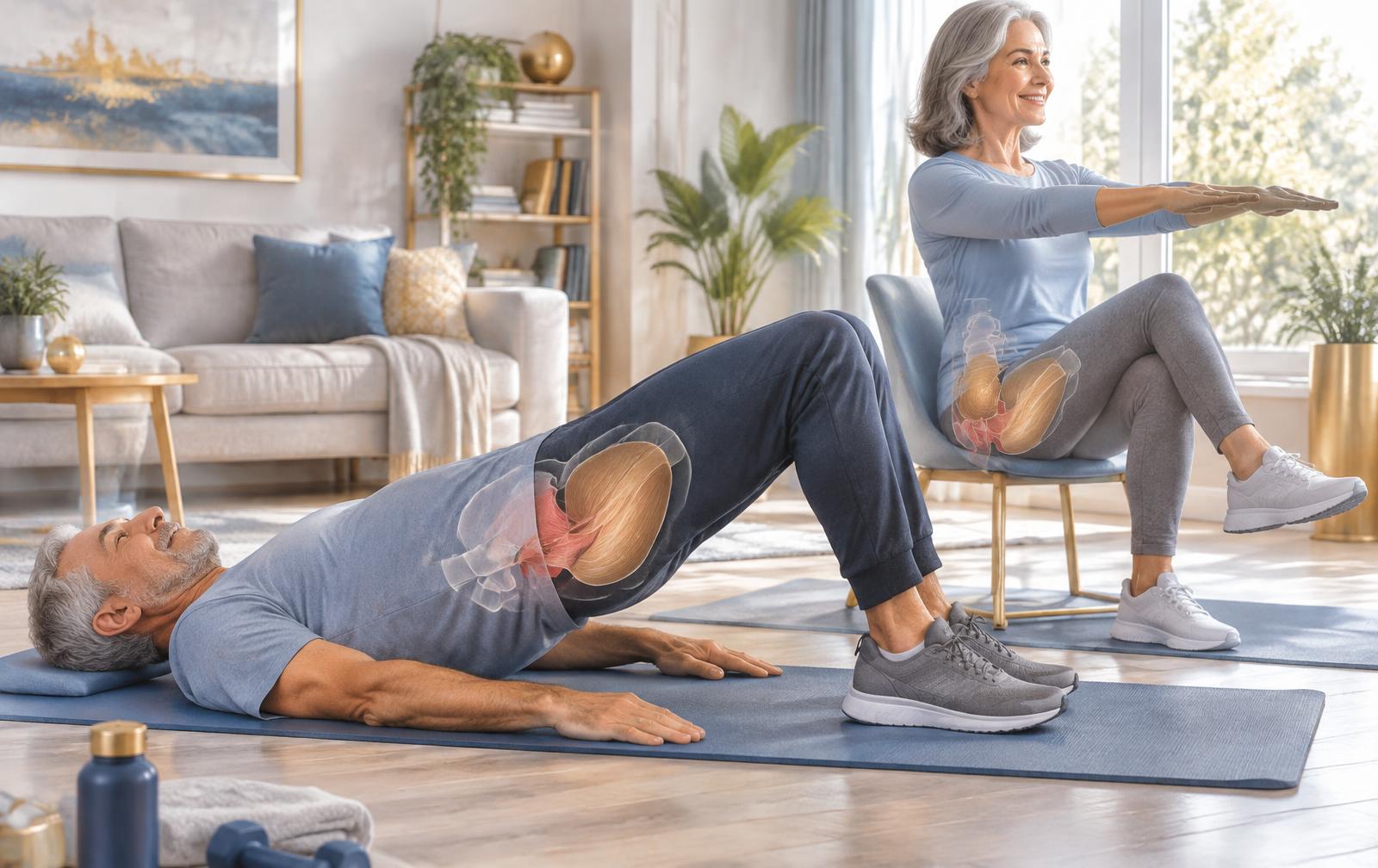
A mature man doing a glute bridge and a woman exercising on a chair, with pelvic floor and gluteal muscles highlighted
The pelvic floor works together with the glutes, abdomen and breath — so we train it in different positions.

For men: the prostate and the muscles that support it

The prostate is the size of a walnut and sits below the bladder, surrounding the urethra. It produces part of the seminal fluid. After 50 it slowly enlarges in most men (benign prostatic hyperplasia, BPH). This is not cancer, but it can press on the urethra: a weaker stream, getting up at night, a feeling of incomplete emptying, dribbling after urinating.

Exercise will not shrink the prostate itself, but it strengthens the muscles around it: the urethral sphincter, the pubococcygeus and the bulbospongiosus. Studies show pelvic floor training reduces dribbling after urination, helps with leakage after prostate surgery and supports erections. Strong glutes, deep abdominal muscles and relaxed diaphragmatic breathing help too.

For women: the pelvic floor throughout life

In women the pelvic floor carries more: pregnancies, births and then menopause, when falling oestrogen weakens the tissues. Typical signs are leaking when coughing, sneezing, laughing or lifting (stress incontinence), sudden urgency, a feeling of heaviness in the vagina, pain during intercourse. It affects up to one in three women over 50 — common, but not „normal”, and it can be worked on.

According to NICE and ICS guidelines, pelvic floor muscle training is the first-line treatment for stress incontinence: at least 3 months, several times a day. Relaxation matters too — in some women the muscles are too tense rather than weak. That is why it is best to see a pelvic health physiotherapist once to check you are doing it right.

How to find your pelvic floor muscles

  1. Sit comfortably and relax your belly, buttocks and thighs.
  2. Imagine holding back wind and stopping the flow of urine at the same time. You will feel a lift and squeeze „in and up”.
  3. Men: you will feel the testicles lift slightly and the base of the penis draw in. Women: a squeeze around the vagina and anus.
  4. Breathe freely. Do not clench your buttocks, hold your breath or regularly stop urinating on the toilet — that is only a test, not an exercise.

For both: hips, hip flexors and the iliopsoas

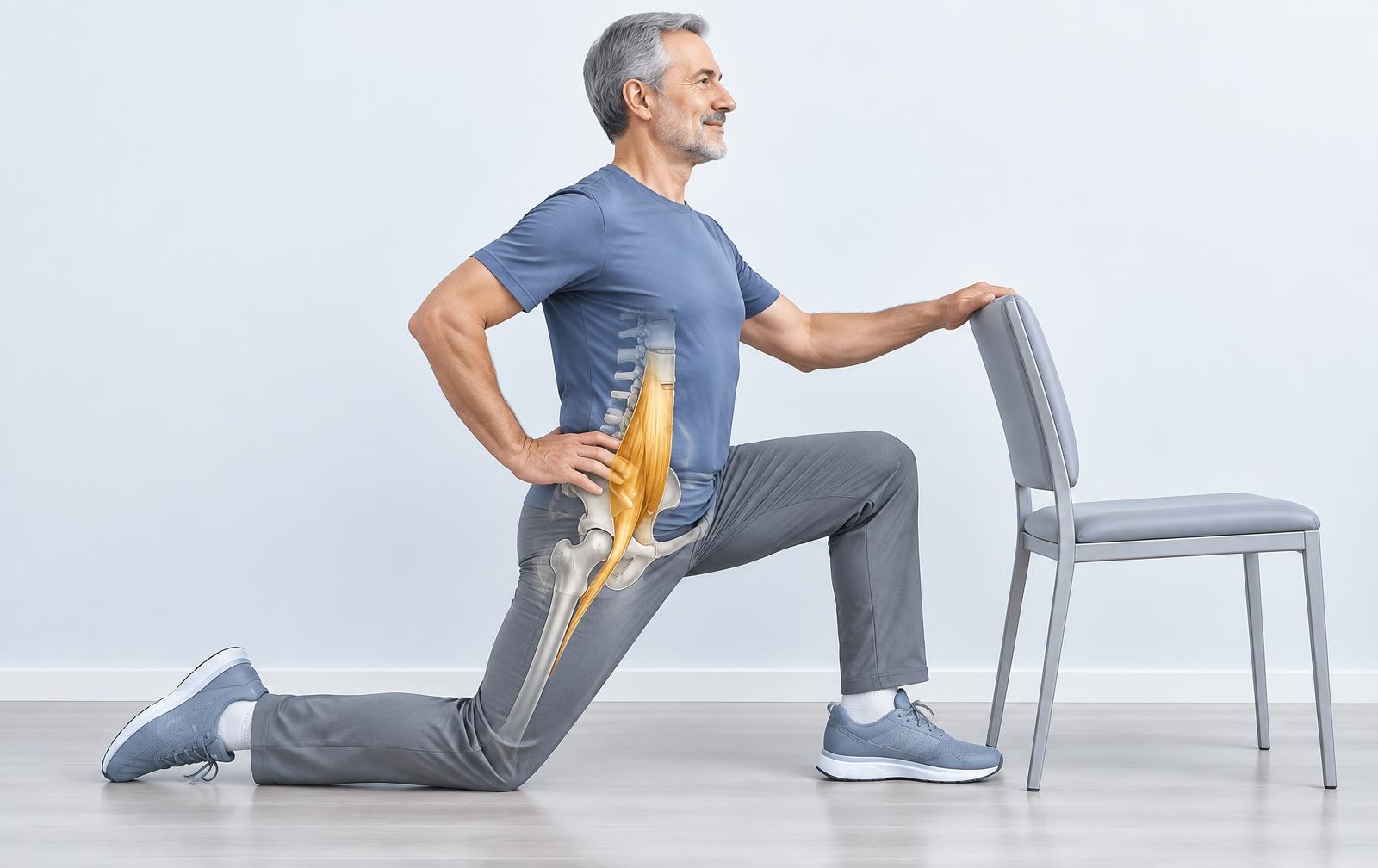
The iliopsoas is the strongest hip flexor: it starts on the lumbar vertebrae and the inside of the pelvis and attaches to the thigh bone. It lifts the knee on the stairs and stabilises the spine. With many hours of sitting it shortens and stiffens. Result: a stooped posture, low back pain when standing up, a shorter step and a higher risk of tripping. At the same time the glutes and hip abductors, which keep you balanced on one leg, weaken. Hip, abdominal and pelvic floor muscles work as one team — we train them together.

A man in a half-kneeling stretch by a chair; the iliopsoas muscle is highlighted
The iliopsoas connects the lumbar spine to the thigh. Long hours of sitting shorten it.

Diet for the prostate, bladder and pelvic floor

No diet cures the prostate, but eating habits affect inflammation, weight and bladder function. The Mediterranean pattern is the best studied.

Eat more often

  • Tomatoes cooked with olive oil (lycopene) — sauces, soups
  • Cruciferous vegetables: broccoli, cauliflower, cabbage, kale
  • Oily fish twice a week, nuts, flaxseed
  • Pumpkin seeds (zinc), legumes, soy and tofu
  • Fibre (whole grains, vegetables, fruit) — prevents constipation, which strains the pelvic floor
  • Water spread across the day, less in the 2 hours before bed

Limit

  • Alcohol and fizzy drinks — they irritate the bladder
  • Too much coffee and strong tea, especially in the evening
  • Processed and red meat, fried food
  • Spicy food and artificial sweeteners if they worsen urgency
  • Excess weight — every extra kilo presses on the bladder and pelvic floor

Massage and relaxation — what is safe at home

Diaphragmatic breathing

Place your hands on your lower ribs. Breathe in through the nose — belly and ribs widen, the pelvic floor gently „drops”. Breathe out through the mouth — the pelvic floor lifts back. 5 minutes a day relaxes tense muscles and lowers stress.

Glute self-massage with a ball

Lean your back against a wall with a ball (tennis or massage) between your buttock and the wall. Roll slowly for 1–2 minutes per side. Pressure should feel pleasant, never painful or radiating down the leg.

Releasing the front of the thigh and hip

Sitting, massage the front and side of the thigh from knee to groin with your hands or a roller for 1–2 minutes. Do not press hard on the groin itself or the abdomen — blood vessels and nerves run there.

Warmth and movement

A warm bath or a hot water bottle on the lower belly and low back relaxes tight muscles. Every 30–45 minutes of sitting, stand up and walk for 2–3 minutes.

Prostate massage is not an exercise to do at home. There is no evidence it improves prostate health, and with inflammation or cancer it can do harm. A rectal prostate examination is carried out only by a doctor (urologist), who decides on any treatment.

When to see a doctor promptly

  • Blood in urine or semen
  • Sudden inability to pass urine — this is an emergency
  • Pain or burning when passing urine, fever
  • Unexplained bone, low back or pelvic pain, weight loss
  • Women: a feeling of a „bulge” in the vagina, bleeding after menopause
  • Men over 50 (over 45 with prostate cancer in the family): talk to your doctor about a PSA test

Three popular myths

„Leaking urine is a normal part of ageing.”

It is common, but for most people it improves clearly after 3 months of pelvic floor training.

„Kegels are only for women.”

Men have the same muscles. Training helps with dribbling, after prostate surgery and with erections.

„The harder and longer I squeeze, the better.”

The muscle must also be able to relax. Fully letting go after each squeeze is as important as the squeeze itself.

4-week plan: pelvic floor and hips

Checking access…

What this guide is based on

  • NICE NG123 (2019) — Urinary incontinence and pelvic organ prolapse in women
  • NICE CG97 (2015) — Lower urinary tract symptoms in men
  • EAU Guidelines (2024) — Non-neurogenic male LUTS; Prostate cancer
  • Dumoulin C. i wsp., Cochrane Review (2018) — Pelvic floor muscle training for urinary incontinence in women
  • Anderson C.A. i wsp., Cochrane Review (2015) — Conservative management for incontinence after prostate treatment
  • International Continence Society (ICS); WHO — Guidelines on physical activity (2020)

This guide is educational and does not replace a visit to a doctor or physiotherapist.

See the free workout